
Game
Stencils
Drawing the fundamental principles of games, so designers can see the structure they are moving through. Published as it happens: sketches, reading notes and open questions.
We are all metanauts.

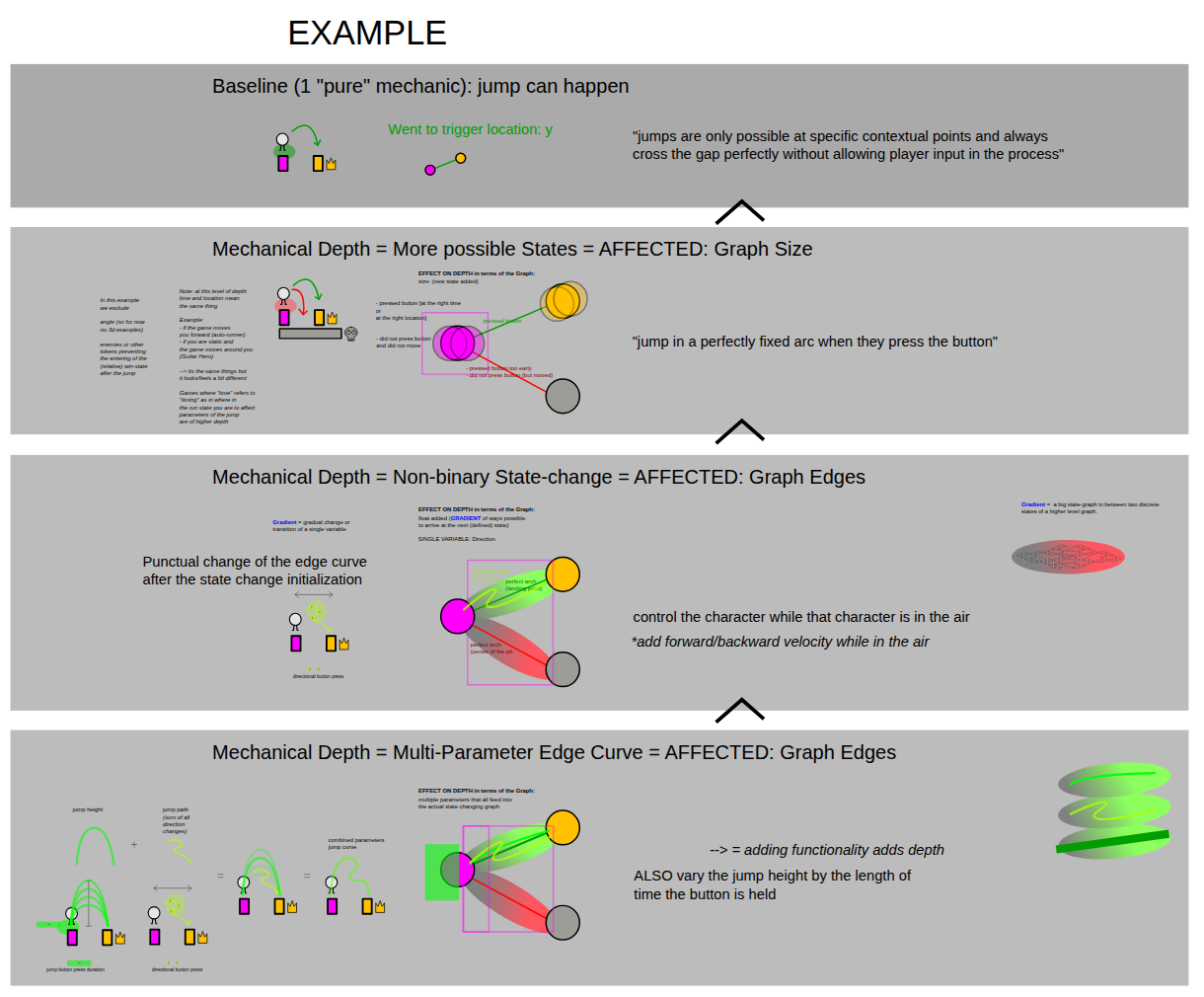
“Mechanical depth” is two things
One jump, made deeper step by step: first more possible states, then a non-binary state change, then an edge curve driven by several parameters. Drawn as state graphs, the steps do not change the same thing.
The term mechanical depth seems to conflate changes to the size of the graph and changes to the curve of the graph’s edges.
Everything so far, newest first
Entries are short and unfinished on purpose. A diagram, a reading note, an open question. New entries appear whenever the research moves, newest first.
“Mechanical depth” is two things
One jump, made deeper step by step: first more possible states, then a non-binary state change, then an edge curve driven by several parameters. Drawn as state graphs, the steps do not change the same thing.
Are there five layers in the stencil model?
Reading Jenkins, Ryan and de Certeau next to Nitsche’s five planes of game space. If the planes hold, the stencil model may need five layers too.
Book structure vs. game structure
Volume, chapter, situation on one side. Structure, scenario, situation and state space on the other, with the designer’s jobs next to them: organisation, pacing, optimisation, bug fixing.
What counts as “relevant”?
An agent, its context, other agents and things without agency. Which of the stacked layers above the real world does a stencil need to show?
Game design is metanautics
Game designers travel through a metaspace of possible games. The article introduces the metanauts and the metanautical pyramid.
Game Stencils – visualising fundamental game principles
The lecture that started the log: foundational shapes, spatial elements and navigation as a structural metaphor.
One shape: the graph
The model has a single foundational shape. Every stencil, from “game” to “playthrough”, is drawn on the same graph.
Game
The foundational stencil: every game as a graph of states and the transitions between them.
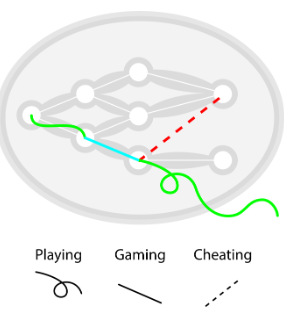
Playing · gaming · cheating
Three ways through the same graph: wandering, taking the efficient route, or skipping the rules altogether.
Play · Playthrough · …
More stencils, one tab each, on their own page soon.
Where the model goes next
Side paths that start from the stencils and wander off. Each one will get its own page.
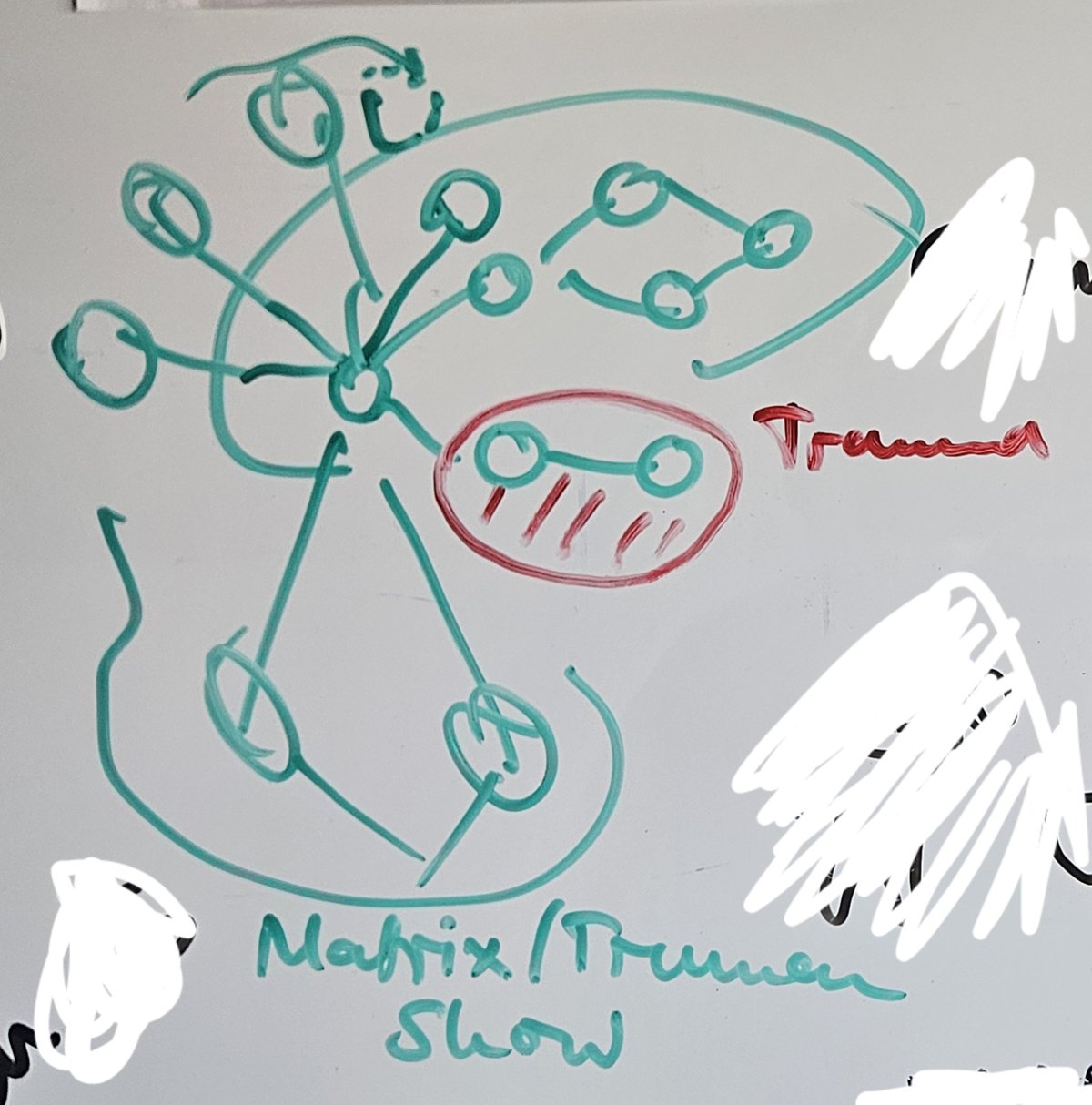
Trauma in a mental graph
Visualising trauma in a mental graph, and collecting ideas for how that could lead to new kinds of gameplay.
Playing with shapes
The foundational shapes and spatial elements from the lecture, explored as their own side path.

The metanautical pyramid
Game designers are metanauts: they travel through a space of possible games and move between levels of abstraction while they do it. The pyramid names those levels.

Greta Hoffmann
Professor of Game Design at the Cologne Game Lab (TH Köln) and founder of Greater Games. Game Stencils is her long-term research into how the structure of games can be seen, drawn and taught.